
Key takeaways
- NDR runs at 400 Gb/s per port. XDR runs at 800 Gb/s on 200 Gb/s lanes, specified by the InfiniBand Trade Association in October 2023.
- NVIDIA's DGX SuperPOD reference architecture builds a rail-optimised, non-blocking fat tree. At 1,024 GPUs that is 32 leaf switches, 16 spine switches and 2,048 cables.
- An all-optical NDR fabric at that size needs roughly 2,048 twin-port 800G transceivers, two per GPU, before spares.
- SemiAnalysis puts networking at 15 per cent of GB300 NVL72 cluster cost on a three-layer InfiniBand fabric, rising to 18 per cent on four layers, with transceivers 60 per cent of the network spend.
- In July 2026 one distributor quoted some ConnectX-7 configurations at 52 weeks or more. The network can set the go-live date, so it gets ordered alongside the GPUs rather than after them.
A 1,024-GPU InfiniBand fabric built to NVIDIA's reference architecture takes 32 leaf switches, 16 spine switches and 2,048 cables. If those links are optical it also takes around 2,048 transceivers, two for every GPU in the cluster. SemiAnalysis puts networking at 15 per cent of total cluster cost on a three-layer InfiniBand GB300 NVL72 build, rising to 18 per cent on a four-layer network, with transceivers accounting for 60 per cent of the networking line.
None of that appears on a GPU quote.
InfiniBand is a lossless, RDMA-based networking standard governed by the InfiniBand Trade Association, and supplied almost entirely by NVIDIA since it completed its $7 billion acquisition of Mellanox on 27 April 2020. Current generations run at 400 Gb/s per port, called NDR, and 800 Gb/s, called XDR. In a GPU cluster it is the back-end fabric that carries traffic between servers, working alongside NVLink inside the server or rack.
We supply the GPUs and the nodes rather than the switches, so the numbers below are the ones we end up walking buyers through before they talk to a network vendor.
What is InfiniBand, and who owns it?
The specification belongs to the InfiniBand Trade Association, which describes itself as an organisation dedicated to developing and furthering the adoption of RDMA technologies. Volume 1 of the specification covers switches, routers and adapters, and the architecture for managing a fabric. NVIDIA does not own the standard. It is the dominant supplier of the silicon, switches and adapters that implement it, through the former Mellanox business.
The practical difference from Ethernet is what the network does for the GPU rather than what it does per second. InfiniBand offloads remote direct memory access to the adapter, and NVIDIA's Quantum-X800 platform overview lists RDMA, GPUDirect RDMA and GPUDirect Storage as full offloads. The fabric is managed by a subnet manager, which NVIDIA describes as the software-defined networking controller of the cluster and ships inside its Unified Fabric Manager platform.
A GPU cluster runs more than one network. NVIDIA's DGX SuperPOD reference architecture specifies four: a compute fabric, a storage fabric, an in-band management network and an out-of-band management network. The compute fabric is the one this post is about. It carries collective traffic between GPUs, and it is kept away from storage and management traffic so that checkpoint writes and data loading do not compete with gradient exchange.
How fast is InfiniBand?
The IBTA specified XDR in October 2023. With 200 Gb/s per lane, XDR adapters and switches reach what the association called "unprecedented 800Gb/s speeds per port", with switch-to-switch connections at 1.6 Tb/s.
| Generation | Per-lane rate | 4x port rate | Hardware |
|---|---|---|---|
| HDR | 50 Gb/s | 200 Gb/s | Quantum, ConnectX-6 |
| NDR | 100 Gb/s | 400 Gb/s | Quantum-2 QM9700/QM9790, ConnectX-7 |
| XDR | 200 Gb/s | 800 Gb/s | Quantum-X800 Q3400/Q3200, ConnectX-8 |
| GDR | not published | 1.6 Tb/s | roadmap only |
GDR appears on the IBTA roadmap at 1.6 Tb/s per port. No specification release date has been published, and the dates circulating in reseller material disagree with each other, so treat it as a direction rather than a plan.
Older generations exist below HDR, back through EDR, FDR and QDR. If you are buying second-hand kit those rates matter. For a new build they do not.
What makes up an NDR or XDR fabric
Quantum-2, the NDR generation. The QM9700 and QM9790 are 1U switches carrying 64 ports of NDR 400 Gb/s across 32 OSFP cages, for 51.2 Tb/s of aggregate bidirectional throughput. Split the ports and you get up to 128 at 200 Gb/s. The QM9700 is the managed version and the QM9790 is unmanaged. Both come in forward and reverse airflow SKUs, which is a part number decision, not a configuration one: MQM9700-NS2F is power-to-connector and MQM9700-NS2R is connector-to-power. Get it wrong and the switch fights the aisle. NVIDIA's specifications page gives the QM9700 747 W typical with passive cables and 1,720 W maximum with active ones, which is a wide enough range to matter when you size the rack feed.
Quantum-X800, the XDR generation. The Q3400-RA is a 4U air-cooled switch with 144 ports at 800 Gb/s across 72 OSFP cages, and NVIDIA states that a two-level fat tree built from it connects up to 10,368 NICs. That figure is just the topology arithmetic: 144 x 144 / 2, because a non-blocking leaf spends half its ports facing down and half facing up. The Q3400-LD is the liquid-cooled sibling for a 21-inch OCP rack. The Q3200-RA packages two 36-port switches in one box.
Adapters. ConnectX-7 is the NDR adapter, in OSFP and QSFP112 variants. ConnectX-8 is the XDR SuperNIC, running 800 Gb/s over PCIe Gen6 with up to 48 lanes, in single-port OSFP224 or dual-port QSFP112.
SHARP. NVIDIA's in-network reduction protocol performs part of a collective operation inside the switch rather than on the GPUs. The published figure worth quoting is from SHARPv2 on HDR, where doubling AllReduce bandwidth translated into 17 per cent higher BERT training performance in an MLPerf submission. NVIDIA has not published an equivalent bandwidth figure for SHARPv3 or SHARPv4, so anyone quoting one at you is extrapolating.
Unified Fabric Manager. UFM is licensed per managed device, and a valid licence is a prerequisite for installation. It comes in Telemetry, Enterprise and Cyber-AI editions. It is a line item, and it is one of the two or three that go missing from first-draft budgets.
How many switches, NICs and cables does a cluster need?
NVIDIA's DGX SuperPOD reference architecture specifies a rail-optimised, non-blocking, full fat tree. Non-blocking means no oversubscription on the compute fabric, and the cable counts in the reference architecture confirm it: node-to-leaf and leaf-to-spine cables come out equal at every size.
Rail-optimised, and why it is the thing to get right
Each eight-GPU server has eight NICs. NIC 1 in every server connects to leaf switch 1, NIC 2 to leaf switch 2, and so on down the rail. The effect is that the same GPU position across every server in a scalable unit sits one hop from its peers. NVIDIA's reference architecture puts it plainly: traffic per rail is "always one hop away from the other 31 nodes in a SU", and traffic between rails traverses the spine layer.
Two consequences follow, and both cost money if you miss them.
The first is that the fabric is sized for the full scalable unit whether or not you fill it. NVIDIA's guidance is to build the leaf switches and leaf-to-spine cabling for the complete SU and leave the unused portion idle. A half-populated SU does not get a half-sized fabric.
The second is that one node position goes to the fabric manager. NVIDIA notes that a DGX system has to be removed to accommodate UFM connectivity, which is why a four-SU build lands at 127 nodes and 1,016 usable GPUs rather than 128 and 1,024.
The switch count, from the reference architecture
NDR, QM9700 switches, eight GPUs and eight NICs per server:
| GPUs | Servers | NICs | Leaf | Spine | Switches | Cables |
|---|---|---|---|---|---|---|
| 512 | 64 | 512 | 16 | 8 | 24 | 1,024 |
| 1,024 | 128 | 1,024 | 32 | 16 | 48 | 2,048 |
| 2,048 | 256 | 2,048 | 64 | 32 | 96 | 4,096 |
The arithmetic is checkable. A 64-port leaf spends 32 ports down and 32 up. At 512 GPUs that is 16 leaves x 32 uplinks = 512 uplinks, and 512 / 64 = 8 spines. Run it at your own size before anyone quotes you.
The transceiver number people miss
Switch cages on the QM9700 are twin-port, carrying two 400 Gb/s ports each, and NVIDIA's LinkX configuration maps show DGX H100-class systems using four twin-port 800G transceivers to feed eight ConnectX-7 adapters at 400 Gb/s.
For 1,024 GPUs on DGX-style servers, all optical:
- Server side: 128 servers x 4 modules = 512
- Leaf downlinks: 1,024 ports / 2 = 512
- Leaf uplinks: 512
- Spine: 1,024 ports / 2 = 512
That is 2,048 twin-port 800G modules and 2,048 fibre runs, before spares. Two transceivers per GPU. Build the same cluster on HGX servers with eight single-port ConnectX-7 cards and the server side becomes 1,024 single-port modules, pushing the total to roughly 2,560.
This is where the node specification feeds straight into the network bill. NIC count and connector type are decided when you specify the server, and every cable and transceiver on every link follows from that decision.
Cables, and why the leaf switch sits in the GPU rack
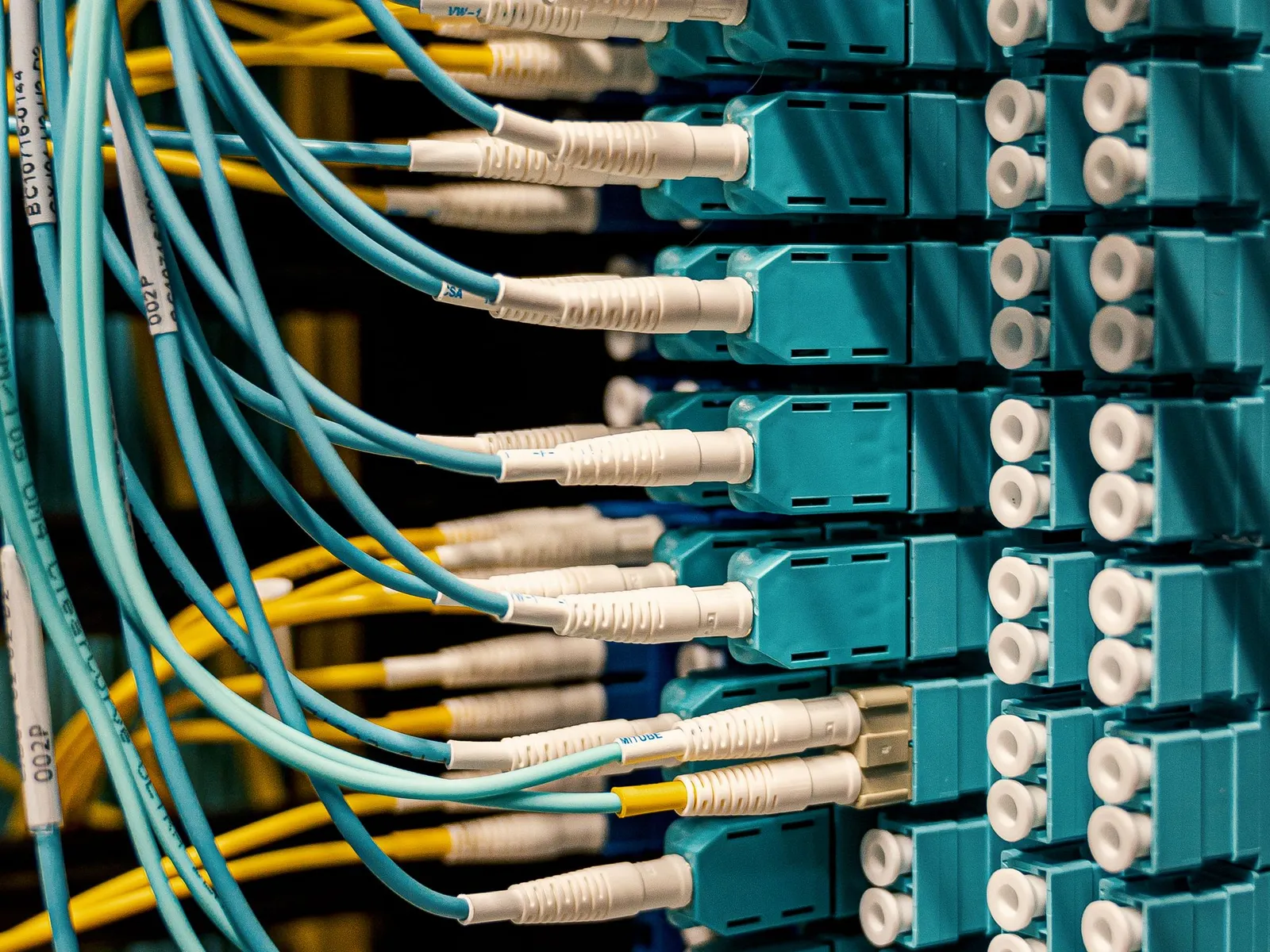
Copper is cheaper, draws no power and fails less. It also runs out of reach quickly. NVIDIA's NDR portfolio lists passive copper at 2 m and active copper at 5 m. On XDR, the switch-to-adapter option is active copper at 2.5 m or optics, and switch-to-switch is active copper at 3 m or twin-port single-mode transceivers with MPO fibre.
So leaf switches belong in or beside the GPU racks if you want copper on the node links. Leaf-to-spine runs crossing a row are going to be optical, and that is the layer where the transceiver count and the power draw both climb.
Do you need InfiniBand, or will Ethernet do?
Both are being bought at scale. Dell'Oro reported that Ethernet switch sales in AI back-end networks more than doubled in the first quarter of 2026 and took about two-thirds of data centre switch sales in AI clusters. In the same release, InfiniBand sales more than tripled on the ramp of 800 Gb/s switches shipping with Blackwell Ultra. NVIDIA's own first-quarter FY2027 call put InfiniBand revenue up more than four times year on year on XDR deployments.
Those two facts are not in conflict. Ethernet is taking share of a fast-growing market while InfiniBand grows quickly from a smaller base, much of it on upgrades to installed fabrics.
What actually separates them at this point is congestion behaviour and tooling rather than line rate. NVIDIA's Spectrum-X materials claim 95 per cent effective bandwidth against 60 per cent for standard ECN-based Ethernet, using adaptive routing and direct data placement. That is a vendor claim, and it is also an admission: getting Ethernet to behave for collective traffic takes work that InfiniBand does by default. On the other side, the Ultra Ethernet Consortium released its 1.0 specification in June 2025, with a new transport and modernised RDMA, backed by AMD, Arista, Broadcom, Cisco, HPE, Intel, Meta and Microsoft.
InfiniBand gives you a single validated design, mature fabric management and in-network reduction. Ethernet gives you multi-vendor supply and staff who already know it. The second of those matters more than it sounds, because an InfiniBand fabric comes from one company.
How does this relate to NVLink?
NVLink is the scale-up domain inside the server or rack. InfiniBand is the scale-out fabric between them. On a GB300 NVL72 the NVLink figure is 1.8 TB/s per GPU, which is 14.4 Tb/s, against 800 Gb/s per GPU of XDR scale-out. That is roughly eighteen to one.
That ratio is the reason parallelism strategy and fabric design are the same conversation. The traffic that benefits most from staying inside the NVLink domain is the traffic you plan for first, and the fabric carries what is left. We covered the node-level half of this in SXM vs NVL vs PCIe, which deals with how many GPUs you can put in one memory domain before the network becomes the answer.
UALink and NVLink Fusion both get raised here. The UALink Consortium published its 2.0 specifications in April 2026, with silicon expected in labs in the second half of 2026. Neither replaces the scale-out fabric. They are scale-up technologies, aimed at the layer NVLink occupies.
Is the network the real gate on a build in 2026?
Sometimes, on specific parts, and the evidence is worth reading carefully rather than repeating as a slogan.
Fusion Worldwide reported in July 2026 that the ConnectX-7 family was quoting "52 weeks or more on multiple configurations", against a typical 20 to 26 weeks a year earlier. ConnectX-8 was allocation-based at launch. The MQM9790-NS2F switch moved from 22 weeks to 42. Broader NVIDIA switch lead times were reaching 24 weeks or more, and 800G and 1.6T transceivers were running 20 to 26 weeks or more. NVIDIA had also begun requiring transceivers to be bundled with Q3400 switch purchases.
Two caveats. Other trade sources put optics past 40 weeks, so the range is wide. And Fusion's own Greensheet in the same month gave ConnectX figures of 20 to 24 weeks or more, which does not match its blog. Lead times in this market vary by buyer, channel and allocation status, and anyone quoting you a single number without a date attached is guessing.
The upstream cause is better evidenced than the lead times themselves. Lumentum told investors in May 2026 that EML laser supply trailed demand by more than 30 per cent, and in August said it was "still shipping behind customer demand on EML". Dell'Oro's view is that the market stays "supply-constrained, rather than demand-constrained, for at least the next one-to-two years".
Set that against GPU lead times in the same period, which ran from 4 to 6 weeks on some listed systems to 3 to 7 months on Blackwell with unstable allocations, and the picture is this. For a buyer who already holds GPU allocation, the network can become the critical path. For a buyer who does not, the GPUs can still be the longer wait. Order the fabric alongside the GPUs rather than after them. The parts people forget are the ones with the longest clocks.
What to order first
- Optics and the NICs that match your node specification. Longest clocks in the build, and both are decided by the server spec.
- Leaf and spine switches. On Q3400 the transceivers have to be bundled at purchase, so the switch order and the optics order are one decision.
- Copper. Short reach, short lead time, order once the rack layout is fixed.
- GPU servers, timed so GPUs are not sitting in a cage waiting for a fabric.
Get the node spec right before you price the fabric
We supply the GPUs and the nodes, not the switches. The node still sets most of the fabric bill. How many NICs it takes, and which connector they use, decides the cable and transceiver type on every link in the cluster.
Send your node spec and GPU count. You will get the GPU configuration and a port count you can hand to your network vendor without it moving later. Nodes are ready and online in four to six weeks, running from compliance approval and payment in full.
Set that against a fabric line quoted at 40 weeks and the sequencing answers itself.
If you would rather not procure a fabric at all, our single-tenant clusters come built and cabled, with the fabric specified to the workload rather than to a house standard. InfiniBand or Ethernet, at the generation the job needs.
Lead-time figures in this article are as of November 2026 and move fast.
Frequently asked questions
What is InfiniBand used for?
Who owns InfiniBand?
How fast is InfiniBand?
Is InfiniBand faster than Ethernet?
Do I need InfiniBand for a GPU cluster, or will Ethernet do?
What is the difference between NVLink and InfiniBand?
What is a rail-optimised topology?
How many InfiniBand switches does a 512-GPU cluster need?
Do InfiniBand lead times really exceed GPU lead times?
About the editorial team
-
 Chief Executive Officer at Deep Leaf Infra. Co-founder and Former CEO of 4DS Memory, concept through commercial stage. Serial entrepreneur; VC Investor and Startup Advisor.
-
 Chief Operating Officer. Technically reviewed this article.